For more information, Click Here
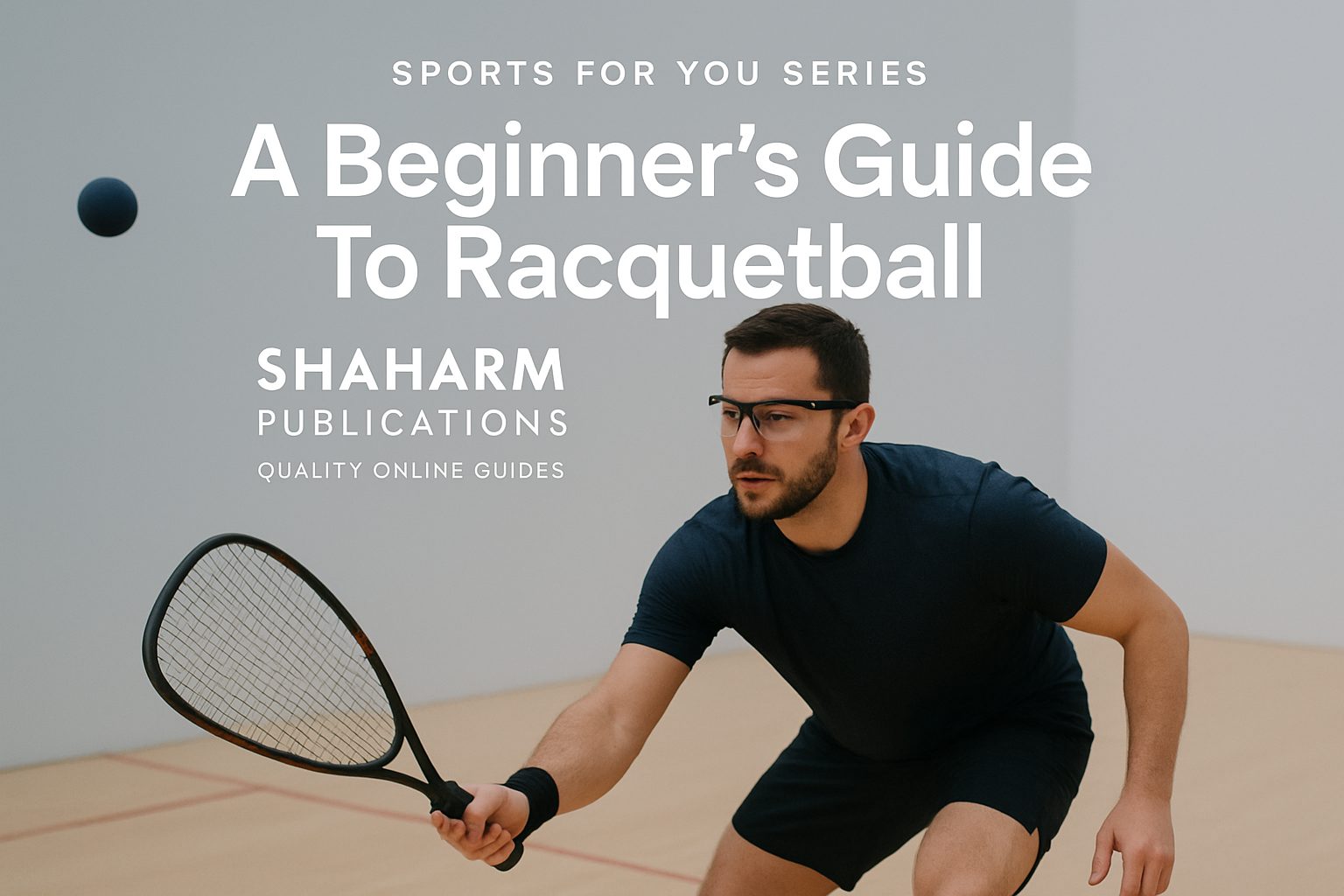
This guide provides an introduction to the sport of racquetball, covering its basic rules and essential equipment. It explains the fundamentals of gameplay, including court dimensions and scoring methods. The content outlines techniques for serving, returning, and positioning during matches. It also offers tips for beginners to improve their skills and enjoy the game safely.
Book Summary
Racquetball Origins & Evolution
Invented in 1949 by Joseph Sobek, racquetball emerged from a combination of tennis and handball principles.
Originally called "paddle racquets," it evolved from paddles to specialized short-handled racquets and adopted
a custom rubber ball for optimal bounce. The sport peaked in popularity during the 1970s with international
adoption and professional tournaments, though participation declined in subsequent decades due to shifting
fitness trends.
Essential Equipment Overview
Racquet Selection Guide
- Lightweight (150-164g): High maneuverability, preferred by advanced players
- Medium (165-174g): Balanced power and control, ideal for intermediates
- Heavy (175g+): Maximum power, recommended for beginners
Ball Color Specifications
- Blue: Standard bounce, beginner-friendly
- Purple/Green: Tournament speed, high visibility
- Red: Heaviest, fastest, outdoor preferred
- Black: Soft, slow, senior-friendly
Game Fundamentals
Played on a 20'x40' court with front, back, and side walls. Matches are played to 21 points,
requiring two wins for victory. Only the serving player/team can score points. The ball must
strike the front wall first on serves and can rebound off other surfaces during play.
Advanced Strategies
Serving Techniques
- Drive Serve: Low, powerful shots to back corners
- Jam Serve: Side-wall spins for unpredictability
- Pinch Serve: Low side-wall shots forcing lunges
Rally Strategies
- Jam Rally: Powerful rebounds to overwhelm opponents
- Pass and Pinch: Back court dominance followed by front court drops
- Momentum Rally: Direction changes against opponent's movement
Fitness & Training
Comprehensive training includes cardiovascular conditioning (running, swimming, aerobics),
full-body stretching (neck, shoulders, core, legs), and strength training (chest, shoulders,
arms, core, legs). Proper warm-ups and equipment maintenance are essential for performance
and injury prevention.
Health Benefits
- 600-800 calories burned per hour of casual play
- Improved cardiovascular and respiratory function
- Enhanced coordination, agility, and balance
- Stress relief through endorphin release and social interaction
- Full-body muscle engagement and weight management
Review
Ank Sheckler's A Beginner's Guide To Racquetball is a standout introduction to the sport, offering a well-researched and highly accessible resource for newcomers. The book excels in its clarity, breaking down complex rules and techniques into digestible segments that are easy to follow. Sheckler's writing is straightforward and engaging, making it an ideal companion for someone picking up a racquet for the first time.
One of the book's strongest qualities is its practical usefulness. From detailed equipment guides—such as selecting the right racquet weight and understanding ball specifications—to step-by-step instructions on serving techniques and rally strategies, the content is immediately applicable. The sections on fitness and health benefits are particularly insightful, providing readers with a holistic view of how racquetball contributes to overall wellness.
Compared to other introductory sports guides, such as A Beginner's Guide To Basketball or A Beginner's Guide To Volleyball, Sheckler's work distinguishes itself with its depth of historical context and strategic nuance. The overview of racquetball's origins and evolution adds richness, helping readers appreciate the sport beyond the basics.
If there is one area for improvement, it would be the inclusion of more visual aids, such as diagrams or photographs, to complement the written descriptions of advanced techniques. While the text is clear, visual learners might find additional imagery helpful for mastering complex moves. That said, this is a minor point in an otherwise comprehensive guide.
Overall, A Beginner's Guide To Racquetball is a valuable resource that effectively balances instruction with inspiration. It’s a must-read for anyone looking to get started in the sport or improve their foundational skills. The book is available for purchase on Amazon here.
For readers interested in exploring similar topics, the publisher offers other insightful works like A Beginner's Guide To Running and A Beginner's Guide To Bowling, which maintain the same commitment to clarity and practicality.