For more information, Click Here
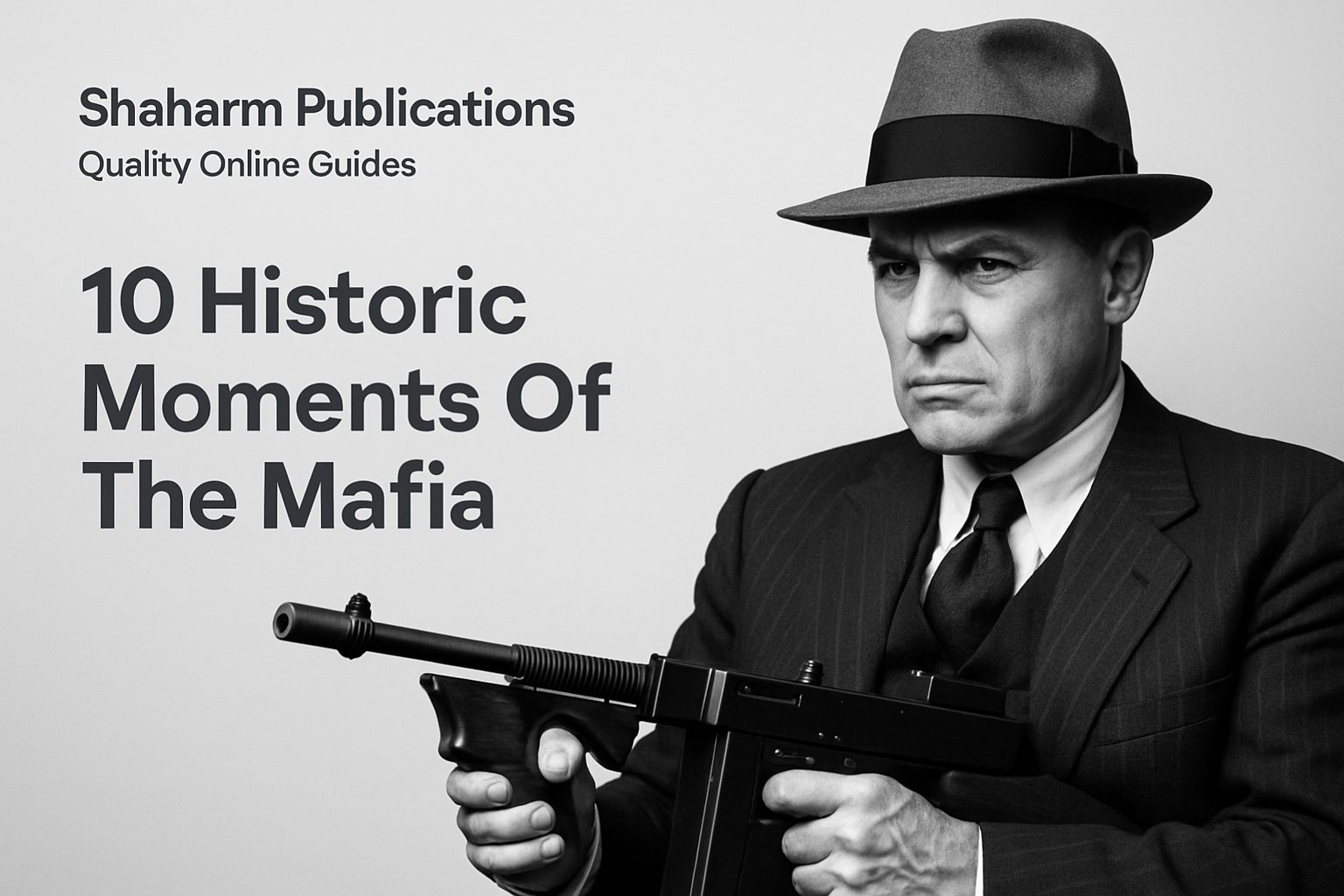
This book explores ten key events that have shaped the history of organized crime. It provides a factual overview of significant occurrences involving criminal groups. The content is based on documented records and historical accounts. Readers will find a straightforward presentation of these moments without embellishment. The focus remains on the impact and context of each event.
Book Summary
Summary: The American Mafia
Organizational Structure
The American Mafia operates through a hierarchical structure with regional families. Key positions include:
- Don/Boss: Ultimate authority and decision-maker
- Underboss: Second in command, potential successor
- Consigliere: Advisor and mediator
- Capos: Captains overseeing crews
- Soldiers/Made Men: Rank-and-file members
- Associates: Non-Italian collaborators
Major Divisions
Five main organized crime groups with Italian origins:
- Sicilian Mafia
- Camorra (Naples)
- Calabrian 'Ndrangheta
- Sacra Corona Unita (Puglia)
- La Cosa Nostra (American Mafia)
Criminal Operations
Key revenue streams include:
- Extortion and protection rackets
- Drug trafficking
- Illegal gambling
- Labor union infiltration
- Money laundering through legitimate businesses
- Prostitution and loan sharking
Cultural Codes
The organization maintains strict codes of conduct:
- Omertà: Code of silence prohibiting cooperation with authorities
- Commandments: Rules governing behavior and loyalty
- Vendetta: System of revenge and honor disputes
- Blood oath initiation rituals
Historical Development
Key historical phases:
- Late 19th century: Initial immigration from Sicily
- 1920s Prohibition: Major expansion through bootlegging
- Post-Prohibition: Diversification into other criminal enterprises
- 1980s-90s: Major RICO prosecutions
- 21st century: Continued operations despite law enforcement pressure
Notable Families & Figures
Prominent organizations and individuals:
- Five Families of New York: Gambino, Genovese, Lucchese, Colombo, Bonanno
- Chicago Outfit (Al Capone)
- Notable bosses: Lucky Luciano, John Gotti, Paul Castellano
- Famous turncoats: Joseph Valachi, Sammy Gravano
Review
Oliver Crompt's 10 Historic Moments Of The Mafia offers a compelling and well-researched examination of the key events that have shaped the American Mafia and its Italian counterparts. The book stands out for its clarity and accessibility, presenting complex historical and organizational details in a manner that is both engaging and informative. Crompt’s writing is concise yet thorough, making the subject matter approachable for readers who may be new to the topic while still offering depth for those with prior knowledge.
One of the book’s strongest qualities is its meticulous research. Crompt draws from a wide range of credible sources, including court documents, historical records, and firsthand accounts, to construct a narrative that is both accurate and vivid. The organizational structure of the Mafia is explained with precision, detailing the roles of the Don, Underboss, Consigliere, Capos, Soldiers, and Associates, as well as the cultural codes like Omertà that have defined the organization’s operations and ethos.
Compared to other works on organized crime, such as those focusing solely on biographical accounts of notorious figures, 10 Historic Moments Of The Mafia distinguishes itself by contextualizing individual events within the broader historical sweep of the Mafia’s evolution. This approach provides a more holistic understanding of how moments like Prohibition-era bootlegging or the RICO Act prosecutions of the 1980s fundamentally altered the trajectory of organized crime.
While the book excels in its narrative and analytical strengths, it could benefit from a slightly deeper exploration of the socio-economic factors that fueled the Mafia’s rise and persistence. Although Crompt touches on immigration patterns and economic opportunities, expanding this aspect would add another layer to the reader’s understanding. That said, this is a minor point in an otherwise comprehensive and insightful work.
For readers interested in further historical explorations from the same publisher, I recommend checking out 10 Historic Moments Of British Monarchy, 10 Historic Moments Of Technology, and 10 Historic Moments Of War. Each offers the same clear, focused approach to pivotal historical events.
Overall, 10 Historic Moments Of The Mafia is a valuable addition to the literature on organized crime, balancing readability with scholarly rigor. It is highly recommended for anyone seeking a nuanced understanding of the Mafia’s impact on American and global history. The book is available for purchase on Amazon here.