For more information, Click Here
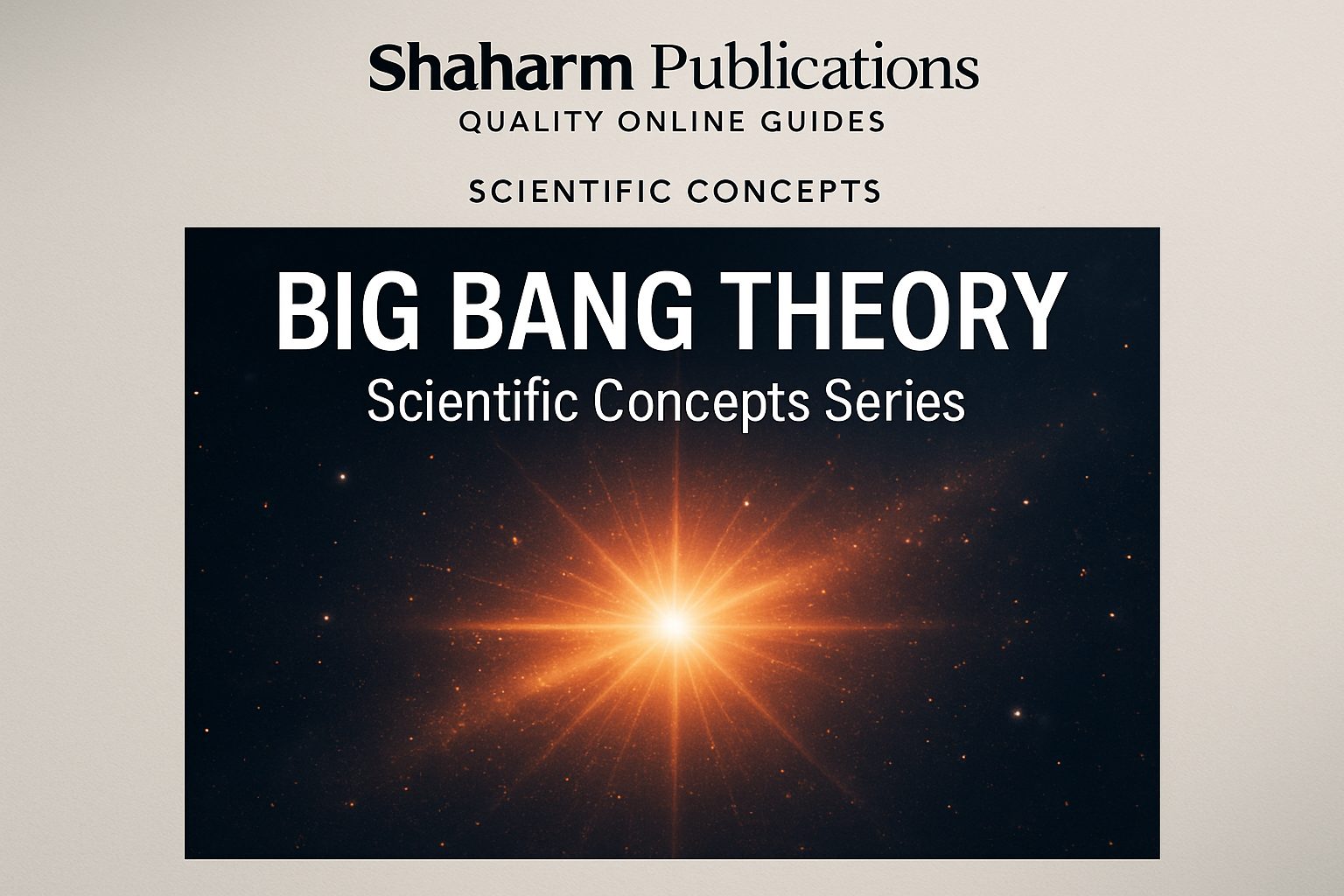
This book explores the Big Bang Theory, detailing the scientific framework that describes the origin and evolution of the universe. It covers key concepts such as cosmic expansion, the formation of elements, and the evidence supporting the theory. The content is structured to provide a clear understanding of fundamental principles in cosmology. It is designed for readers interested in the foundational ideas of modern astrophysics.
Book Summary
The Big Bang Theory: Historical Development and Scientific Evidence
The Big Bang theory, now universally accepted as explaining the origin of the universe, gained scientific consensus only in the 1960s. Prior to this, many scientists believed in a static, eternal universe with no beginning. Key discoveries by astronomers like Edwin Hubble, who found that galaxies are moving away from us and the universe is expanding, challenged this view and laid the foundation for the Big Bang theory.
Key Evidence and Discoveries
- Hubble's Observations: Discovered galaxies moving away from us, with more distant galaxies receding faster, indicating universal expansion.
- Cosmic Microwave Background (CMB): Predicted by George Gamow and accidentally discovered in 1964, this residual radiation from the Big Bang provided crucial evidence.
- Element Formation: The theory explains the abundance of light elements like hydrogen and helium formed in the early universe.
Theoretical Framework
The universe began as a singularity—an infinitely hot, dense point smaller than an atom. This singularity rapidly expanded (not exploded) in an event known as inflation, doubling in size numerous times within the first fractions of a second. As it expanded and cooled, fundamental forces separated, matter formed, and eventually atoms, stars, and galaxies emerged.
Ongoing Research and Implications
Current research focuses on understanding what triggered the Big Bang and what preceded it. Theories like cosmic inflation suggest the possibility of a multiverse. Studies of dark energy indicate the universe's expansion is accelerating, ruling out a "Big Crunch" scenario and suggesting a future where galaxies, stars, and even atoms may eventually dissipate.
Review
Barry Bingham's Big Bang Theory is a remarkably clear and well-researched exploration of one of the most profound scientific concepts of our time. Bingham excels at distilling complex cosmological ideas into accessible language without sacrificing depth or accuracy. The book’s structure is particularly effective, beginning with the historical context of the theory’s development—including the pivotal contributions of figures like Edwin Hubble—before moving into the key evidence, such as the cosmic microwave background and nucleosynthesis, which solidified the Big Bang as the leading explanation for the universe’s origin.
What sets this book apart from others in the genre, such as similar titles in the Theory of Relativity series from the same publisher, is its balance of narrative storytelling and scientific rigor. Bingham’s prose is engaging and avoids unnecessary jargon, making it an excellent choice for both newcomers and those with some prior knowledge. The sections on ongoing research, including dark energy and cosmic inflation, are thoughtfully presented and reflect up-to-date scientific inquiry.
If there is one area where the book could be enhanced, it would be in the inclusion of more visual aids or diagrams to illustrate some of the more abstract concepts, such as the rapid expansion during inflation or the geometry of the universe. While the text is lucid, supplementary visuals could provide an additional layer of clarity for readers who benefit from graphical representations.
Overall, Big Bang Theory is an insightful and highly readable account that demystifies a cornerstone of modern cosmology. It stands as a valuable resource for anyone looking to deepen their understanding of the universe’s beginnings. The book is available for purchase on Amazon here.